
Facebook, Uber, Snapchat, Airbnb, Instagram, Spotify — today these are billion-dollar platforms with advanced features and polished designs. But none of them started that way. Each one launched as a stripped-down version with just enough functionality to test a single idea with real users.
Take Facebook as an example. When it first went live in February 2004, it was a basic social network built only for Harvard University students. The features were minimal — a user profile, a news feed, friend requests, and photo albums. There were no reels, no marketplace, no stories. Just a simple MVP.
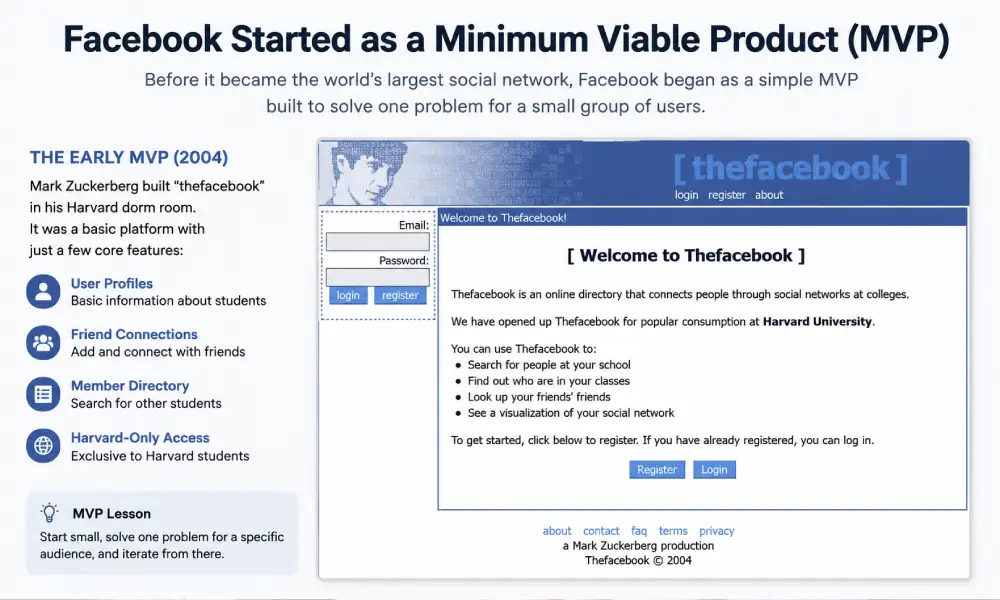
Over time, based on real user feedback, the platform grew. Today it has nearly 3 billion monthly active users. The lesson is straightforward: starting with a minimum viable product (MVP) is one of the smartest ways to test a business idea without burning through your entire budget upfront.
An MVP lets you launch fast, learn from actual users, refine your product, and — importantly — attract investor funding before you have built the full version. This guide walks through everything you need to know about how to build an MVP, how much it costs, and how to use it to raise money.
Table of Contents
- Top 4 MVP Development Benefits That Attract Investors
- Real-World Examples of Companies That Started With MVPs
- How to Build an MVP — Step by Step
- How Much Does It Cost to Develop an MVP?
- How to Find Investors and Raise Funding on Your MVP
- Types of Funding Partners for MVP Fundraising
Top 4 MVP Development Benefits That Attract Investors
MVP development has become a standard starting point for startups and growing businesses alike. The reason is simple — it reduces risk, speeds up learning, and gives investors something real to evaluate. Here are the four most important benefits.
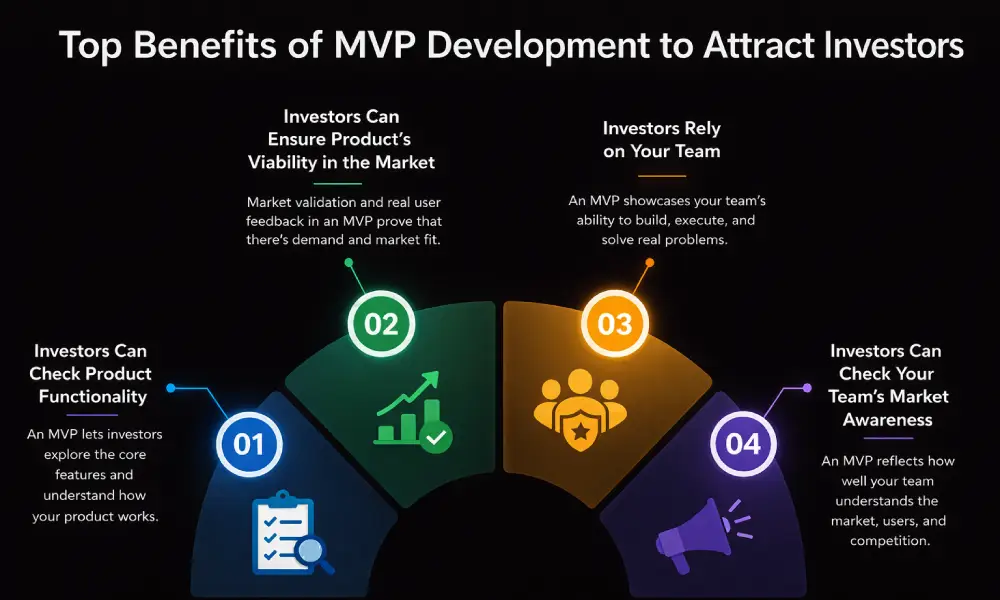
1. Investors Can See the Product Working
A product that exists — even in a basic form — is far easier to pitch than a concept on a slide deck. An MVP gives investors something tangible to interact with. They can see how the product works, understand the core user flow, and judge whether the idea solves a real problem.
Products still in the planning or design stage are much harder to evaluate. An MVP removes that uncertainty. It also signals to investors that the team has moved beyond theory and is capable of execution — which is often more important than the idea itself.
2. Investors Can Evaluate Market Demand
The primary purpose of an MVP is to test whether the market actually wants what you are building. It means gathering data on whether users engage with the product, whether they return to it, and whether they are willing to pay for it.
This real-world validation is what separates a good pitch from a great one. When you can show an investor that users are already using and responding to the product, the conversation shifts from “will this work?” to “how fast can this grow?” — which is a much easier position to raise funding from.
3. Investors Are Betting on the Team
Experienced investors consistently say the same thing: they back people, not just ideas. A well-built MVP demonstrates that your team has the skills, discipline, and focus to turn a vision into working software.
Shipping an MVP — even a simple one — shows that your team can manage priorities, make product decisions, and deliver. That track record gives investors the confidence they need, especially in early-stage rounds where there is limited financial history to rely on.
4. Investors Can See Your Market Understanding
Building an MVP requires real research. You have to understand your target users, study the competitive landscape, identify the core problem worth solving, and decide which features matter most for version one. Investors know this. When they see a functioning MVP, they see proof that you have done that work — not just pitched an idea.
Market awareness matters because the business environment shifts quickly. An MVP shows that your team can identify opportunities, adapt to feedback, and make informed decisions rather than moving on assumptions alone.
Real-World Examples of Companies That Started With MVPs
Some of the most recognized technology companies in the world got their start with a basic MVP. Here are three well-known examples.
Snapchat
In 2011, two Stanford University students built a simple photo-sharing app called Picaboo — which later became Snapchat. The MVP had just one feature: photos that disappeared after a few seconds. That single idea was enough to attract millions of users. After proving the concept worked, the team gradually added 10-second videos, Stories, and chat features. Today, Snapchat has more than 363 million daily active users worldwide.
Airbnb
The founders of Airbnb had a tight budget and a simple idea: rent out space in their apartment to visitors. Their MVP was not even an app — it was a basic website with a few photos and a booking option. The goal was simply to check whether anyone would pay to stay in a stranger’s home. They did. That early validation gave the founders the proof they needed to build the full platform and eventually scale to millions of listings globally.
Uber
The idea behind Uber came from frustration with expensive and unreliable taxis in San Francisco. The founders built a minimal iPhone app that connected riders with nearby drivers and allowed credit card payments. Nothing more. The MVP tested whether people wanted a better way to get around — and the answer was a clear yes. Uber has since grown into one of the most valuable companies in the world, with a market cap of over $95 billion.
How to Build an MVP — Step by Step
Building an MVP is not about cutting corners. It is about being deliberate — choosing the right features to validate the right assumptions before investing in a full build. Here is the process.
Step 1: Conduct Market Research
Before writing a single line of code, understand the market you are entering. Who are your potential users? What problems are they dealing with today? What solutions already exist, and where do those solutions fall short?
Use surveys, interviews, competitor analysis, and existing data to build a clear picture of the opportunity. This research forms the foundation of every decision you make during MVP development. Teams that skip this step often build something technically functional but commercially irrelevant.
Step 2: Identify Your Target Users
Once you understand the market, narrow your focus to a specific user segment. Define who your early adopters will be — the people most likely to use your product first and give you the feedback you need.
Ask yourself: Who has this problem most urgently? Who is currently working around the problem with a makeshift solution? Who would immediately see value in what you are building? The more precisely you define this group, the more useful your early feedback will be.
Step 3: Define Core Features Only
This is where most first-time founders struggle. The temptation is to build everything. Resist it.
List every feature you want the product to have. Then cut the list aggressively. An MVP should contain only the features necessary to solve the core problem for your target user. Everything else can be added later based on feedback. A focused product is also easier to build, easier to explain, and easier for users to understand — all of which help during investor conversations.
Step 4: Build and Launch
With a clear scope defined, build the MVP and get it in front of real users as quickly as possible. Speed matters here — the goal is to learn, and you cannot learn until the product exists in the hands of actual people.
Launch to a small, targeted group rather than a broad audience. This keeps feedback manageable and allows you to spot patterns quickly. Promotion can be simple at this stage — direct outreach, community groups, or a small paid campaign is often enough to get early users.
Step 5: Collect and Analyze Feedback
After launch, gather feedback systematically. Track how users interact with the product, where they get stuck, which features they use most, and what they say when asked directly. Combine quantitative data from analytics with qualitative insights from interviews and support conversations.
Use this feedback to prioritize the next round of improvements. An MVP will always have gaps — that is expected. What matters is how quickly and accurately you identify those gaps and act on them.
How Much Does It Cost to Develop an MVP?
MVP development costs significantly less than building a full product, but the range is wide depending on what you are building. On average, the cost to develop a minimum viable product falls somewhere between $15,000 and $150,000.
Several factors affect where you land in that range:
- Product complexity — the more features and integrations, the higher the cost
- UI/UX design requirements — a polished design takes more time than a functional but basic one
- Development team location — rates vary significantly by geography
- Industry-specific requirements — healthcare or fintech MVPs often require compliance work that adds cost
To give a rough sense of typical ranges:
- A video-calling app MVP: approximately $30,000 – $50,000
- A food delivery app MVP: approximately $42,000 – $51,000
- A real estate platform MVP: approximately $45,000+
These numbers are starting points, not fixed quotes. The right way to get an accurate estimate is to define your feature scope clearly and then discuss it with an experienced development team.
How to Find Investors and Raise Funding on Your MVP
Having a working MVP puts you in a strong position to raise funding. But the process of finding and convincing the right investors requires preparation and strategy.
Research Your Investors Before Approaching Them
Not all investors are looking for the same thing. Before reaching out, study each investor’s portfolio, investment thesis, and stage preference. Approach investors who have previously backed companies in your industry or at your stage of development.
This research also helps you tailor your pitch. An investor who has funded multiple fintech startups will have different questions than one focused on consumer apps. Showing that you understand their perspective builds credibility from the first conversation.
Lead With the Future, Not the Past
Investors are not primarily interested in what you have already built. They are interested in where the product is going. Your pitch should communicate the market opportunity clearly — how large it is, how quickly it is growing, and why your product is positioned to capture a meaningful share of it.
Use your MVP data to support these claims. If early users are returning regularly, that is evidence of demand. If a small paid campaign drove a meaningful number of sign-ups at a low cost, that supports your growth thesis. Numbers always land better than projections alone.
Build a Pitch That Speaks to Their Goals
A compelling investor pitch focuses on what matters to the specific investor you are talking to — not everything about your product. Highlight the business metrics that are most relevant: user growth, engagement rates, early revenue, cost of acquisition, or retention. Connect these to the return they can expect.
Keep the pitch focused and honest. Overselling creates problems later. Investors who feel misled do not stay on your cap table for long, and the startup ecosystem is smaller than it appears.
Prepare for Difficult Questions
Investors will probe for weaknesses. The competitive landscape, your team’s ability to scale, the risks of your technology choices, your go-to-market plan — all of these will come up. Prepare honest, well-reasoned answers for the hard questions rather than deflecting them.
Showing that you have thought through the risks — and have a plan for managing them — is often more reassuring to investors than projecting false confidence.
Know Your Numbers Before You Walk In
Have a clear picture of your current burn rate, your runway, and exactly how you intend to use the money you are raising. Investors expect founders to know these numbers precisely. A vague answer to “how will you use the funding?” is a red flag. A specific, prioritized plan demonstrates operational maturity.
Types of Funding Partners for MVP Fundraising
Once your MVP is ready, you have several funding paths available. The right one depends on your industry, location, and how much you are looking to raise.
Community Development Financial Institutions (CDFIs)
CDFIs focus on supporting businesses in underserved communities. If your product is aimed at low-to-moderate income markets or you are based in a qualifying area, CDFIs can be a good source of early-stage capital with terms that are more flexible than traditional lenders.
Government Grants and Programs
Federal, state, and local governments offer a range of programs to support early-stage businesses — including grants, low-interest loans, and tax incentives. These vary significantly by country and region, but they are worth researching before pursuing private investment, as they typically do not require giving up equity.
Angel Investors and Venture Capitalists
Angel investors are typically high-net-worth individuals who invest their own money in early-stage companies, often in exchange for equity. Venture capital firms invest pooled funds and usually come in at a slightly later stage, though many do fund pre-revenue startups with strong MVPs.
Both groups prioritize teams with strong domain knowledge, a clear market opportunity, and evidence of early traction — all of which a well-built MVP helps demonstrate.
Crowdfunding
Crowdfunding platforms allow you to raise money from a large number of small contributors. This works best when you have a product with a compelling story that resonates with a broad audience. A successful crowdfunding campaign also doubles as a marketing exercise — it builds an early user base and generates buzz before the full product launches.
Friends and Family
For many early-stage founders, the first funding comes from people in their personal network. If family members or close friends believe in the idea and want to support it, this can provide the capital needed to build the MVP without giving up equity to institutional investors too early. Treat these investors with the same transparency and professionalism you would extend to any professional investor.
Planning to build an MVP for your startup or business idea? The team at Try Digital Solution helps founders and businesses go from concept to working product — fast. Get in touch to discuss your project.